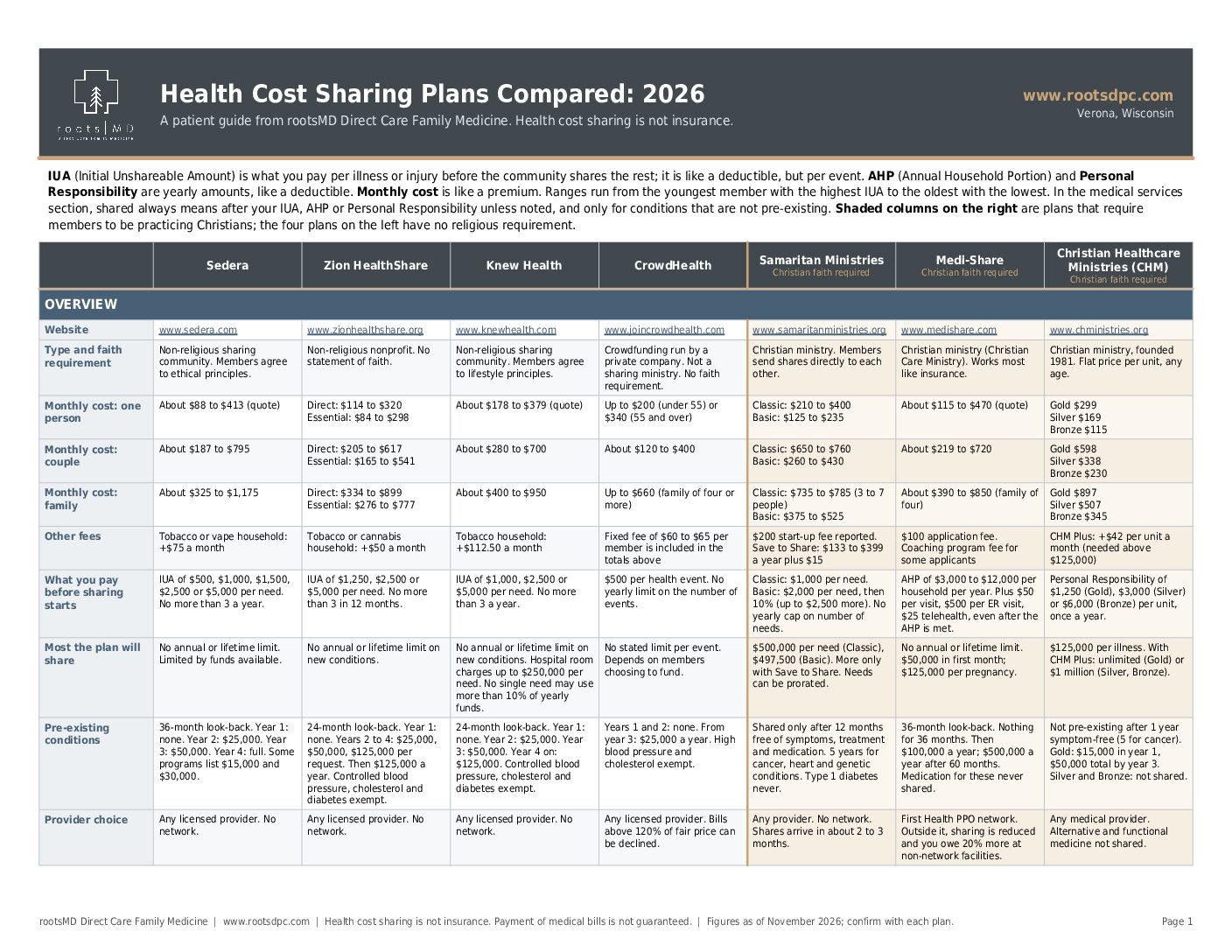
Health insurance has become unaffordable for many of the families we see at rootsMD, a Direct Primary Care family medicine practice in Verona, Wisconsin, serving the Madison area. The enhanced Affordable Care Act (ACA) premium tax credits expired at the end of 2025, and many households now pay far more for marketplace coverage (KFF). Patients often ask us whether a health cost sharing plan is a reasonable alternative, so we put together this comparison of seven plans.
Health cost sharing is not insurance. Members pay a set amount each month, and the community shares members’ large, eligible medical bills under written guidelines. No plan is legally required to pay a bill, and none has to follow ACA rules. Amounts below are the plans’ published 2026 figures as of November 2026. They can change at any time, so confirm them with the plan before you join.
Reviewed by Amanda Preimesberger, MD, family physician. Last updated November 2026.

Cost sharing vs. ACA insurance
Cost sharing usually wins on monthly cost and provider choice. ACA insurance wins on guaranteed protection.
Advantages of cost sharing
- Lower monthly cost for most healthy households that do not qualify for an ACA subsidy.
- Join any time of year. There is no open enrollment period.
- Most plans let you see any doctor or hospital. There is no network to check (Medi-Share is the exception).
- Pairs well with Direct Primary Care (DPC): your DPC practice handles everyday care and the sharing plan is for large, unexpected bills.
- Members are treated as self-pay patients, which often means lower cash prices.
Disadvantages of cost sharing
- No guarantee of payment. Sharing is voluntary, there is no contract, and state insurance regulators cannot make a plan pay.
- Pre-existing conditions are excluded or capped for the first one to five years. ACA plans must cover them from day one.
- Many plans leave out or limit long-term prescriptions, mental health care, preventive care and treatment for substance use.
- Some plans cap what they share per illness or per year. ACA plans have no annual or lifetime dollar limits.
- No legal limit on what you could owe. ACA plans cap in-network costs at $10,600 per person and $21,200 per family in 2026.
- Rules can change at any time, and membership can end if you stop meeting the plan’s faith or lifestyle requirements.
- You usually pay the bill or negotiate it first, then wait to be reimbursed.
- Monthly amounts cannot be paid with ACA tax credits, and a sharing plan by itself does not let you fund a health savings account (HSA).
Who it tends to fit: generally healthy people who pay full price for insurance, have savings to cover an unexpected bill or two, and already have a primary care home such as a DPC practice.
Who should be cautious: anyone with a chronic condition, expensive ongoing medication, a planned surgery or a pregnancy already under way, or an income that qualifies for an ACA subsidy or Medicaid.
Before you join
This is not a complete list of available cost sharing plans. It covers the plans our patients ask about most often. rootsMD does not endorse or recommend one plan over another; that choice belongs to each patient and family. Plans change their rules often, so treat this guide as a starting point and read the current guidelines before joining. Sedera, Medi-Share and Knew Health price by quote, so your rate may differ from the ranges shown.
Terms to know
- Monthly contribution (or monthly share): what you pay each month to stay a member. Similar to a premium.
- IUA (Initial Unshareable Amount): what you pay yourself for each new illness or injury before the community shares the rest. Similar to a deductible, but it applies per event, not per year. Several plans stop charging it after three needs in 12 months.
- AHP (Annual Household Portion, Medi-Share) and Personal Responsibility (CHM): what you pay toward eligible bills each year before sharing starts. Similar to an annual deductible.
- Medical need: one illness or injury and all the care related to it. Similar to a claim.
- Eligible or shareable expense: a bill the plan’s guidelines allow to be shared. Similar to a covered service.
- Co-share: a percentage of the bill you still pay after the IUA or AHP. Similar to coinsurance.
- Pre-existing condition: a condition with symptoms, testing, treatment or medication before you joined, usually looking back two to three years.
- Sharing limit or cap: the most the community will share per need, per year or per lifetime.
- Proration: if members’ bills exceed contributions in a month, every bill is shared at a reduced percentage.
- Guidelines: the written rules for what is shared. They are not a contract and can be changed.
Plans at a glance
Sedera, Zion, Knew Health and CrowdHealth have no religious requirement. Samaritan Ministries, Medi-Share and Christian Healthcare Ministries (CHM) are for practicing Christians. Each range runs from the youngest member with the highest IUA to the oldest member with the lowest.
For a side-by-side view of all seven plans, download our full comparison chart (PDF).
Monthly cost and what you pay first
| Plan | One person (per month) | Family (per month) | What you pay before sharing starts |
|---|---|---|---|
| Sedera | About $88 to $413 | About $325 to $1,175 | IUA of $500 to $5,000 per need; no more than 3 per year |
| Zion HealthShare Direct | $114 to $320 | $334 to $899 | IUA of $1,250, $2,500 or $5,000 per need; no more than 3 in 12 months |
| Zion HealthShare Essential (through a DPC practice or employer) | $84 to $298 | $276 to $777 | Same as Direct |
| Samaritan Ministries Classic | $210 to $400 | $735 to $785 (3 to 7 people) | $1,000 per need |
| Samaritan Ministries Basic | $125 to $235 | $375 to $525 | $2,000 per need, then 10% of the rest (up to $2,500 more) |
| Medi-Share | About $115 to $470 | About $390 to $850 (family of four) | AHP of $3,000 to $12,000 per household per year, plus $50 per visit and $500 per emergency room visit |
| CHM Gold / Silver / Bronze | $299 / $169 / $115 | $897 / $507 / $345 | $1,250 / $3,000 / $6,000 per unit per year |
| Knew Health | About $178 to $379 | About $400 to $950 | IUA of $1,000, $2,500 or $5,000 per need; no more than 3 per year |
| CrowdHealth | Up to $200 (under 55) or $340 (55 and over) | Up to $660 (family of four or more) | $500 per health event |
Sedera, Medi-Share and Knew Health price by personal quote, so their ranges are estimates from an independent tracker (WhichHealthShare). The other amounts come from each plan’s own 2026 rate sheet or guidelines. Tobacco users pay more or cannot join.
Protection and fit
| Plan | Most the plan will share | Pre-existing conditions | Provider choice | DPC fit |
|---|---|---|---|---|
| Sedera | No annual or lifetime limit | Nothing in year 1; $25,000 in year 2; $50,000 in year 3; full sharing in year 4 | Any licensed provider; no network | Good: lower-priced programs for DPC patients |
| Zion HealthShare | No annual or lifetime limit on new conditions | Nothing in year 1; $25,000, $50,000, then $125,000 per request in years 2 to 4; $125,000 per year after that | Any licensed provider; no network | Good: Essential membership is built for DPC patients |
| Knew Health | No annual or lifetime limit on new conditions; hospital room charges up to $250,000 per need | Nothing in year 1; $25,000 in year 2; $50,000 in year 3; $125,000 from year 4 | Any licensed provider; no network | Good: 10% discount with a DPC membership |
| CrowdHealth | No stated limit per event | Nothing in years 1 and 2; $25,000 per year from year 3 | Any licensed provider | Neutral: no discount; DPC fees not funded |
| Samaritan Ministries | $500,000 per need (Classic); more with Save to Share | Shared only after 12 months free of symptoms and treatment; 5 years for cancer, heart and genetic conditions | Any provider | Fair: DPC fee shareable up to $100 a month during a shared need |
| Medi-Share | No annual or lifetime limit; $125,000 per pregnancy | Nothing for 36 months; then $100,000 per year; $500,000 per year after 60 months | First Health PPO network; extra cost outside it | Limited: DPC credit only on the $12,000 AHP |
| CHM | $125,000 per illness; unlimited (Gold) or $1 million (Silver, Bronze) with CHM Plus | Gold: $15,000 in year 1, rising to $50,000 total by year 3. Silver and Bronze: not shared until one year symptom-free | Any medical provider | Neutral: no DPC discount or credit found |
More about each plan
Sedera
A non-religious sharing community and one of the plans most often paired with DPC. More information: sedera.com.
- Financial reliability: operated as a fund of a nonprofit that files IRS Form 990. We could not find a public audit, so ask for the latest one.
- Catastrophic protection: no annual or lifetime limit; sharing is limited by the funds available. Physical, occupational and speech therapy are each limited to $3,000 a year and counseling to $750 a year.
- DPC: optional, with lower-priced programs for members of a DPC practice. Routine and preventive care is mostly left to you or your DPC practice, so there is little overlap.
- Pre-existing conditions: 36-month look-back. Some program summaries list lower limits ($15,000 and $30,000) than the table above, so confirm which applies to you.
- Also know: maternity has a separate IUA of twice your regular IUA, up to $5,000; an elective C-section is $5,000 to $7,500 depending on the program. Long-term medicines for a new condition are shared for 120 days only. Tobacco or vape households pay $75 more a month.
- Eligibility: ages 18 to 64. Members agree to a set of ethical principles; no religious affiliation is required. Not offered in every state.
Zion HealthShare
A non-religious nonprofit with a membership designed for DPC patients. More information: zionhealthshare.org.
- Financial reliability: strong. Zion posts its financial statements online, holds a 4-star Charity Navigator rating with audited financials, and says about 90% of contributions go to members’ medical bills.
- Catastrophic protection: no annual or lifetime limit on new conditions. Smaller caps apply to some services, such as therapy and tobacco-related disease.
- DPC: the Essential membership is offered through a DPC practice or employer at lower rates. It leaves out the preventive-care sharing that Direct includes, so you are not paying twice. DPC fees themselves are not shared.
- Pre-existing conditions: 24-month look-back. High blood pressure, high cholesterol and diabetes are exempt if controlled and you were not hospitalized for them in the past 12 months.
- Not shared: mental health treatment and medication, diabetic supplies and medication, allergy testing and medication, contraception, sleep apnea and fertility care.
- Eligibility: under 65. Not available in Washington State. No statement of faith. Tobacco or cannabis use adds $50 a month.
Samaritan Ministries
A Christian ministry in which members send their monthly share directly to another member with a medical need. More information: samaritanministries.org.
- Financial reliability: strong. An independent audit is available on request and Form 990 is public. Samaritan reports that 88.4% of dollars went directly from member to member in its 2025 fiscal year.
- Catastrophic protection: up to $500,000 per need on Classic and $497,500 on Basic. Larger needs are shared only if you join Save to Share ($133 to $399 a year plus a $15 fee). If needs exceed shares in a month, every need is reduced by the same percentage.
- DPC: nothing is duplicated, because routine and preventive care is not shared. A DPC fee can be shared up to $100 in any month the physician is consulted for a shareable need.
- Pre-existing conditions: Type 1 diabetes that began before membership is never shared. Controlled high blood pressure and high cholesterol are not treated as pre-existing.
- Not shared: routine and preventive care, counseling and most mental health care, and long-term medication beyond a one-time 120-day supply.
- Eligibility: members affirm a Christian statement of faith, attend church at least three weeks out of four, abstain from tobacco, illegal drugs and sex outside traditional marriage, and drink only in moderation. A pastor or church leader confirms this each year.
Medi-Share
Run by Christian Care Ministry, Medi-Share works most like insurance: it uses a provider network, an annual household amount and per-visit fees. More information: medishare.com.
- Financial reliability: moderate. The guidelines say audited financial statements are available on request.
- Catastrophic protection: no annual or lifetime limit on eligible bills, except $50,000 in the first month of membership and $125,000 per pregnancy.
- Provider choice: the most restricted of the seven. Most states use the First Health PPO network. Outside it, sharing is reduced and you owe an added 20% of charges at a non-network hospital or facility.
- DPC: limited. Only the $12,000 AHP has a DPC option, which counts DPC fees toward the AHP up to $1,800 per family per year. Every level includes telehealth and an annual physical, which overlap with DPC.
- Pre-existing conditions: 36-month look-back, and medication for a pre-existing condition is never shared.
- Not shared: counseling and psychotherapy, most screening and preventive care, and prescriptions beyond six months per new condition. Maternity is for married members only.
- Eligibility: adults attest to a personal Christian faith, attend church regularly, use no tobacco (including vaping) or illegal drugs, and keep sex within Christian marriage. There is a one-time $100 application fee.
Christian Healthcare Ministries (CHM)
Founded in 1981, CHM is the oldest plan here and has the simplest pricing: a flat amount per unit regardless of age. One adult is one unit, a couple is two, and a family of any size is three. More information: chministries.org.
- Financial reliability: strong. Annual audit by an independent accounting firm, available on request. CHM reports administrative costs under 10% and says it has shared 100% of eligible bills since 1981.
- Catastrophic protection: the lowest base limit of the seven, $125,000 per illness. Adding CHM Plus ($42 per unit per month) makes Gold unlimited and raises Silver and Bronze to $1 million per illness.
- Provider choice: any medical provider. Bills from chiropractors, counselors, psychologists and naturopaths are not shared, and neither are bills from physicians practicing alternative or functional medicine.
- DPC: no DPC discount or credit appears in CHM’s published materials. Routine care is not shared, so there is little overlap.
- Also know: maternity has a separate Personal Responsibility of $2,500 (Gold), $5,000 (Silver) or $9,000 (Bronze). Medications are shared for the first 90 days of a new incident only.
- Eligibility: adults must be Christians who attend worship regularly and use no tobacco, nicotine or illegal drugs. There is no age limit.
Knew Health
A non-religious sharing community that includes some preventive care and discounts its rates for DPC patients. More information: knewhealth.com.
- Financial reliability: limited public information. Ask for financial statements before joining.
- Catastrophic protection: no annual or lifetime limit on new conditions, but hospital room charges are limited to $250,000 per need. One further caution: the guidelines say no single need may use more than 10% of the funds available in a year.
- DPC: 10% off the monthly contribution when at least half the household belongs to a DPC practice, with proof each month. The membership still includes its own preventive sharing, which overlaps with DPC.
- Pre-existing conditions: 24-month look-back. Controlled high blood pressure, high cholesterol and diabetes are exempt.
- Not shared: mental health treatment and medication, diabetes medication and supplies, weight-loss drugs, and medicines you were already taking when you joined.
- Eligibility: under 65. No faith requirement. Tobacco households pay $112.50 more a month. Not available in nine states; Wisconsin is not one of them.
CrowdHealth
CrowdHealth is crowdfunding run by a private company, not a sharing ministry: each month members are asked to fund other members’ bills directly. More information: joincrowdhealth.com.
- Financial reliability: mixed. CrowdHealth publishes its funding results each month and reports that about 99% of eligible bills have been funded since 2021. It is a young private company and does not publish financial statements. Nothing is held in a shared pool.
- Catastrophic protection: no stated limit per event, but funding depends on other members choosing to give.
- DPC: no DPC discount, and prepaid memberships are not funded. Nothing is bundled that duplicates DPC.
- Not funded: counseling and outpatient psychiatric care, addiction treatment, brand-name drugs when a generic exists, and high-cost specialty drugs.
- Eligibility: under 65. No tobacco users. Men over 260 pounds and women over 220 pounds cannot join. No faith requirement.
Frequently asked questions
Is health cost sharing the same as health insurance?
No. A health cost sharing plan is a membership in which members share one another’s eligible medical bills under written guidelines. There is no contract and no legal obligation to pay a bill, and the plans do not have to follow Affordable Care Act rules. State insurance regulators cannot require a plan to pay.
Can I use a health sharing plan with Direct Primary Care?
Yes. Many patients pair the two: a Direct Primary Care membership covers everyday and preventive care, and the sharing plan is there for large, unexpected bills. Zion HealthShare and Sedera offer lower-priced memberships for DPC patients, and Knew Health gives a 10% discount.
Which health sharing plans have no religious requirement?
Sedera, Zion HealthShare, Knew Health and CrowdHealth have no religious requirement. Samaritan Ministries, Medi-Share and Christian Healthcare Ministries require members to be practicing Christians.
Do health sharing plans cover pre-existing conditions?
Not right away. Most plans share nothing for a pre-existing condition in the first year, then phase in sharing over two to five years with dollar limits. ACA insurance plans must cover pre-existing conditions from the first day.
How much does a health sharing plan cost?
For the seven plans in this guide, published 2026 monthly amounts run from about $84 to $470 for one person and about $276 to $1,175 for a family, depending on the plan, your age and the amount you agree to pay before sharing starts.
Are these plans available in Wisconsin?
As of November 2026, none of the seven plans lists Wisconsin as an excluded state. Availability can change, so confirm with the plan before you join.
Sources
- KFF: Marketplace costs after the enhanced tax credits expired and 2026 ACA out-of-pocket limits
- Georgetown Center on Health Insurance Reforms: Health care sharing ministry data
- Sedera: community FAQ and member principles
- Zion HealthShare: member guidelines and 2026 rates
- Knew Health: member guidelines
- CrowdHealth: member guide and pricing
- Samaritan Ministries: October 2026 guidelines
- Medi-Share: guidelines and summary of sharing
- Christian Healthcare Ministries: programs and FAQ
- WhichHealthShare: 2026 plan comparison (quote-based rate estimates)
This guide is general information, not insurance, legal or tax advice. rootsMD does not sell or receive payment from any of these plans. Figures were read from each plan’s website or guidelines in November 2026, with quote-based rates from WhichHealthShare. ACA figures are from KFF.

